

Skip to content
  • Link to LinkedIn
  • Link to Facebook
  • Link to Instagram
  • Link to Threads
  • English EN
    • ES
    • Portuguese
  • APPOINTMENT
  • Careers
Call Us: +1 (305) 792-8677
HarrisLaw | Miami Immigration Lawyer | EB-5 H-1B NIW Visa Expert
  • Home
  • Our Team
    • Why Choose a Board Certified Attorney?
    • Michael A. Harris
    • Maria Ortega
  • Practice Areas
    • Investment Immigration
      • EB-5 Investment Program
        • EB-5 Project Developers
        • EB-5 Investors
      • E-2 Investment Visas
    • Business Immigration
      • H-1B Specialty & Professional Workers
      • L-1 Visas for Multinational Companies
      • O Visas for Extraordinary Ability Persons
      • E-1 Treaty Traders
      • E-2 Investment Visas
      • E-3 Visas for Australians
      • Entertainer & Athlete Visas
        • Athletes & Sports Teams
        • P-1 Visas for Essential Support Personnel
        • P-1B Visas for Entertainment Groups
        • Other P Visa Types
      • TN Visas for Canadians & Mexicans
      • Healthcare Worker Certification
    • Employment-Based Green Cards
      • Labor Certification
      • Schedule A
      • EB-1 Visa: First Preference Employment-Based Immigration
        • Extraordinary Ability Persons
        • Outstanding Professors and Researchers
        • Multinational Managers or Executives
      • EB-2, Second Preference Workers
        • National Interest Waivers
      • EB-3 Visa: Skilled Workers, Professionals, and Unskilled Workers
      • EB-5 Immigrant Investors
    • Citizenship By Investment
      • St. Kitts and Nevis
      • Malta
      • Portugal
      • Grenada
    • Family Immigration
    • Deportation Defense
    • Other Immigration Services
      • U.S. Embassy Consular Processing
      • Student Visas for Studying in the U.S.
      • Tourist Visas for Business & Pleasure
      • J-1 Exchange Visitors, Trainees & Interns
      • U.S. Citizenship & Naturalization Applications
  • EB-5
    • EB-5 Investors
    • EB-5 Project Developers
    • EB-5 News
  • NIW
  • Blog
  • Contact Us
  • Click to open the search input field Click to open the search input field Search
  • Menu Menu

IMMIGRATION LAW UPDATE Read More Independence day. flag usa
EB-5 Adjustment of Status After the New USCIS Memo: What Investors Should Know

May 23, 2026 | By Michael A. Harris

USCIS announced that it has issued a new policy memorandum that may affect how officers review adjustment of status applications, including Form I-485 applications filed by EB-5 investors. The memo attempts to reframe adjustment of status as an extraordinary form of discretionary relief, rather than as a regular statutory pathway for eligible applicants already in the United States.

For EB-5 investors, this issue is practical and immediate. Adjustment of status has become a central part of EB-5 planning, especially after the EB-5 Reform and Integrity Act of 2022. Many investors in the United States have relied on the ability to file Form I-485 when a visa is available, including through concurrent filing. A pending I-485 may allow eligible investors and family members to remain in the United States while the case is pending, apply for employment authorization, and apply for advance parole.

The new USCIS memo does not eliminate adjustment of status. It does not repeal the EB-5 Reform and Integrity Act. It does not repeal INA §245(n). It does not repeal INA §245(k). It does not say that EB-5 investors are categorically barred from adjustment. But it may make EB-5 adjustment filings more evidence-driven, more discretionary, and more vulnerable to officer scrutiny.

The key question is whether USCIS will apply the memo narrowly or broadly. A narrow application would allow officers to consider real negative factors, such as fraud, unauthorized employment, serious status violations, criminal conduct, or inconsistent statements to immigration officials. A broad application would treat the act of filing adjustment itself as disfavored because consular processing was available. That broader approach is where the memo becomes legally vulnerable, especially for EB-5 investors.

Adjustment of Status Is a Statutory Pathway, Not a Loophole

Adjustment of status is the process that allows an eligible person in the United States to become a lawful permanent resident without leaving for an immigrant visa interview abroad. The general authority is INA §245(a), 8 U.S.C. §1255(a). The statute allows adjustment where the applicant was inspected and admitted or paroled, is eligible for an immigrant visa, has a visa immediately available, and is admissible to the United States.

USCIS is correct that adjustment is discretionary in many cases. INA §245(a) says that status “may” be adjusted. But that does not mean USCIS can convert adjustment into a rare exception that exists only when consular processing is impossible or when extraordinary circumstances exist.

Congress created adjustment. Congress limited adjustment. Congress created bars to adjustment. Congress created exceptions to those bars. For EB-5 investors, Congress recently enacted a special provision directly addressing EB-5 adjustment filing. That statutory structure matters. USCIS may exercise discretion, but discretion should not become a substitute for a new eligibility rule that Congress did not enact.

The EB-5 Reform and Integrity Act Changed the Analysis

The most important EB-5-specific statute is INA §245(n), 8 U.S.C. §1255(n), added by the EB-5 Reform and Integrity Act of 2022. That provision states:

If the approval of a petition for classification under section 203(b)(5) would make a visa immediately available to the alien beneficiary, the alien beneficiary’s application for adjustment of status under this section shall be considered to be properly filed whether the application is submitted concurrently with, or subsequent to, the visa petition.

This language is central to the EB-5 analysis. Congress did not merely leave EB-5 adjustment to general agency discretion. Congress specifically addressed EB-5 adjustment filing and provided that, when the statutory conditions are met, an EB-5 investor’s adjustment application is properly filed whether submitted concurrently with or after the EB-5 petition.

That does not guarantee approval. USCIS may still adjudicate the I-526E. It may still review source and path of funds, sustainment, job creation, project compliance, admissibility, fraud, national security concerns, and discretion. But the mere fact that an EB-5 investor used the concurrent adjustment process should not be treated as negative where Congress expressly made that filing posture proper.

This is one of the strongest legal answers to the new memo. If USCIS treats EB-5 adjustment as inherently suspect because the investor could have consular processed, it risks contradicting the statute Congress enacted for EB-5 investors.

EB-5 Is an Economic Benefit Category

EB-5 is also different because it is an economic immigration category. The fifth employment-based preference is for people who invest significant funds in the United States and create or maintain jobs for U.S. workers. That is not incidental to EB-5. It is the purpose of the program.

This matters because, after the memo was released, USCIS appeared to qualify its public position in a statement reported by Business Insider. USCIS reportedly stated that while it works to operationalize the policy, applicants who provide an “economic benefit” or are otherwise “in the national interest” will likely be able to continue on their current path, while others may be asked to apply abroad depending on individualized circumstances.

That statement is potentially important for EB-5 investors. EB-5 investors should be among the clearest examples of applicants who can claim economic benefit. They invest capital. Their projects must create jobs. Many EB-5 projects involve construction, operations, regional development, business expansion, infrastructure, hospitality, health care, manufacturing, or other U.S. economic activity.

But investors should not treat that statement as a safe harbor. It is not a statute, regulation, or binding USCIS Policy Manual provision. USCIS has not yet defined what “economic benefit” or “national interest” means in this context. Until formal guidance is issued, EB-5 investors should assume that officers may still conduct a searching discretionary review.

The practical lesson is that EB-5 adjustment filings should affirmatively document the economic benefit of the investment. The filing should not simply include the I-485 forms and assume that EB-5 eligibility speaks for itself. It should explain the investment, the project, the job creation, the source and path of funds, the business activity, and why the investor’s adjustment supports the purpose of the EB-5 program.

Because USCIS may issue more guidance, and because agency implementation may evolve, investors should check this blog for updates.
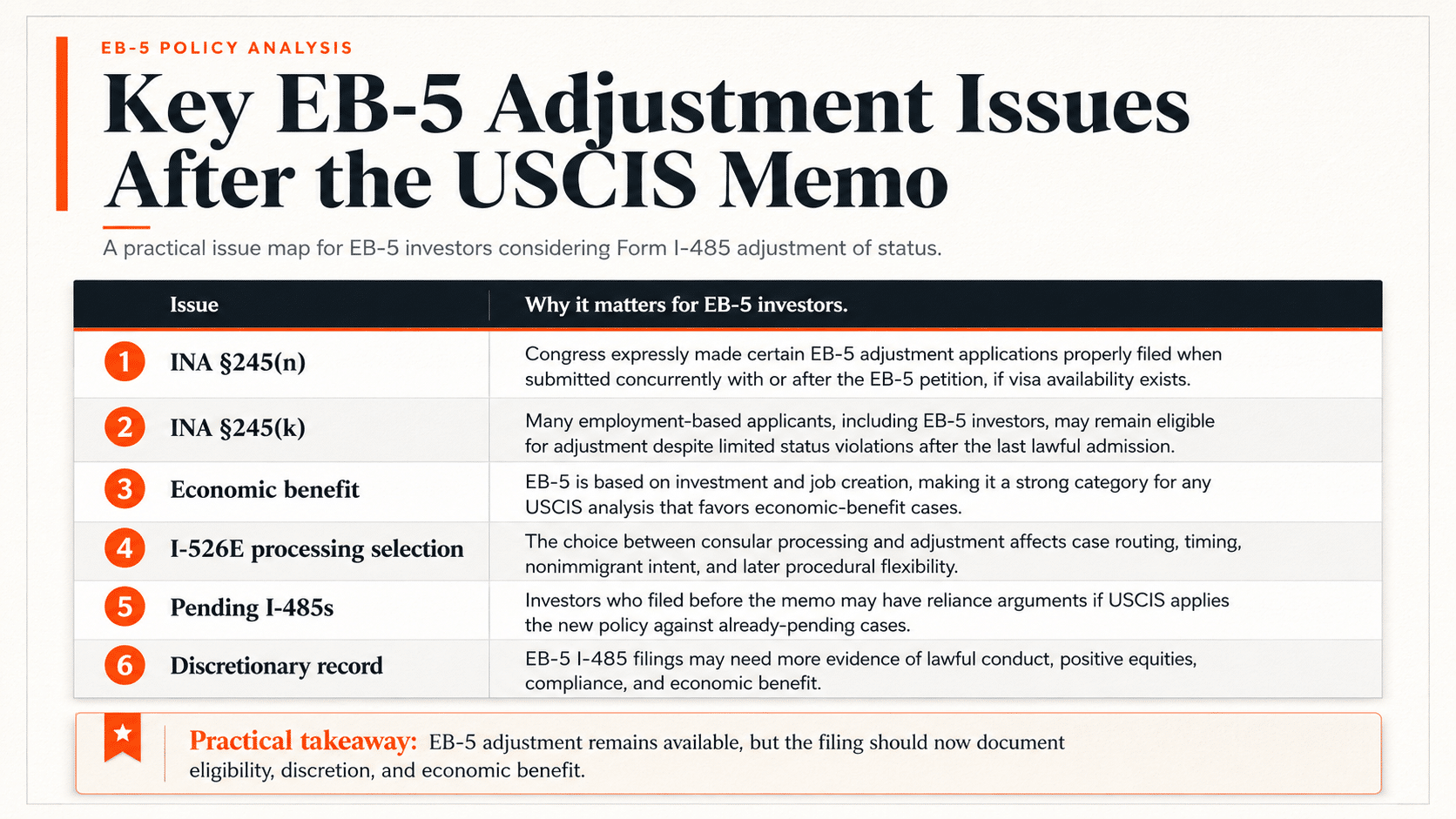
chart of EB5 AOS guidance

INA §245(k) Remains Important

INA §245(k), 8 U.S.C. §1255(k), allows many employment-based applicants to remain eligible for adjustment despite limited periods of unauthorized employment, failure to maintain lawful status, or other violations of the terms of a nonimmigrant visa, if the aggregate period after the last lawful admission does not exceed 180 days.

This provision matters for EB-5 investors in two ways. First, it may preserve eligibility for an investor who has a short gap in status, a brief period of unauthorized employment, or another limited violation. Second, it shows that Congress expected employment-based applicants to adjust status inside the United States even where limited violations occurred. Congress did not say such applicants must leave and consular process. It created a specific forgiveness rule.

USCIS may argue that §245(k) preserves eligibility but does not guarantee favorable discretion. That is true. But USCIS should not use discretion to erase the forgiveness Congress created. If a violation falls within §245(k), USCIS may still consider the full record, but it should not treat a forgiven violation as though Congress never enacted §245(k).

For EB-5 investors, the practical point is simple: if §245(k) is relevant, calculate it carefully, document it clearly, and explain it affirmatively.

The I-526E Processing Selection Matters

The new USCIS memo also makes the Form I-526E processing selection more important.

Part 6 of Form I-526E requires the investor to identify how they intend to seek lawful permanent resident status. The investor must select either immigrant visa processing abroad or adjustment of status. The instructions likewise direct the petitioner to select the appropriate box for either immigrant visa processing abroad or adjustment of status.

That selection may not be irrevocable, but it is not meaningless. It can affect routing, timing, nonimmigrant intent issues, and later procedural steps.

In many cases, selecting consular processing on Form I-526E may preserve more procedural flexibility. If the petition is approved, the case may be routed toward the National Visa Center. If the investor later becomes eligible to file Form I-485 in the United States, INA §245(n) may still permit adjustment if the statutory requirements are satisfied.

The reverse may be less efficient. If the investor selects adjustment of status but later needs consular processing, the approval may not be routed automatically to the National Visa Center. Additional steps may be required to move the case to the Department of State, which can create delay.

This does not mean every investor should select consular processing. Some investors who are already in the United States, eligible to file I-485, and in a strong status posture may reasonably select adjustment. But the choice should be deliberate. It should be made after analyzing visa availability, current status, travel plans, family members, potential retrogression, and whether later adjustment may be available.

EB-5 I-485s May Need to Be Prepared Differently

Historically, many EB-5 adjustment filings focused on eligibility, admissibility, medicals, identity documents, immigration history, and the required forms. Under the new memo, investors should expect more emphasis on discretion.

An EB-5 adjustment filing should be prepared as a legal submission. It should explain why the investor is eligible and admissible, but also why the investor merits adjustment as a matter of discretion.

The record may include evidence of lawful admission, maintenance of status, authorized employment, tax compliance, lack of criminal history, lack of fraud or misrepresentation, family ties, community ties, business activity, job creation, lawful source and path of funds, and the practical disruption that would result from unnecessary consular processing.

For EB-5 investors, the discretionary record should also connect the case to the purpose of the EB-5 program. The investor is not merely asking for convenience. The investor is participating in a congressionally created immigrant investor program designed to bring capital to the United States and create jobs for U.S. workers.

Pending EB-5 I-485 Applications Raise Reliance Concerns

One of the most important unresolved issues is how USCIS will treat EB-5 I-485 applications that were already pending before the memo.

Many investors filed adjustment applications before the memo was issued. Some filed concurrently with Form I-526E under INA §245(n). Some paid substantial filing fees, applied for employment authorization, applied for advance parole, made employment and travel decisions, enrolled children in school, leased or purchased homes, and structured their lives around the pending adjustment process.

The memo does not appear to provide a grandfathering rule or transition period for pending I-485 applications. That creates reliance concerns. The better argument is that USCIS must exercise discretion based on the statute and the facts of the case. It should not treat a pre-memo, statutorily proper EB-5 adjustment filing as an adverse factor merely because the investor used adjustment rather than consular processing.

That argument is especially strong where the investor relied on §245(n). Congress expressly allowed certain EB-5 adjustment applications to be properly filed concurrently with or after the EB-5 petition. USCIS should not use a later policy memo to penalize investors for relying on that statute.

The Case Law USCIS Cites Does Not Fit Modern EB-5 Cleanly

USCIS relies on older administrative and federal cases describing adjustment as discretionary, extraordinary, and not intended to replace consular processing. Those cases support a narrow and familiar point: adjustment is discretionary, and USCIS may deny adjustment where negative factors outweigh positive equities.

But many of the cited cases do not fit modern EB-5 adjustment practice. Many arose in deportation or removal proceedings. Many involved overstays, unauthorized employment, criminal conduct, fraud concerns, preconceived intent, motions to reopen, or judicial review issues. Some predate the modern employment-based preference system created by the Immigration Act of 1990. Some predate the modern EB-5 program. Many predate the EB-5 Reform and Integrity Act of 2022 and INA §245(n).

One case likely to receive attention is Kim v. Meese, because it involved an investor-type adjustment case. But Kim involved a B-1 visitor and pre-modern investor rules. It predates the current EB-5 statutory structure, the 1990 employment-based preference system, the RIA, and §245(n). It may support the general proposition that investor adjustment is discretionary. It does not answer whether modern EB-5 concurrent adjustment under §245(n) can be treated as inherently suspect.

The better reading of the case law is narrower. USCIS may consider real negative facts. It may deny adjustment where the record warrants denial. But the cases do not create a broad rule that EB-5 investors must consular process unless they can prove extraordinary circumstances.

Investor Status and Family Issues Still Matter

EB-5 investors in the United States may be in many different nonimmigrant classifications. The specific status matters, but the analysis is highly fact dependent.

Investors in H-1B or L-1 status usually have stronger arguments because those are dual-intent classifications. Investors in E-2 or O-1 status may also have favorable arguments, depending on the facts. F-1 students require more careful planning because F-1 is not a classic dual-intent category. B-1/B-2 visitors require the most caution because visitor status is temporary and may create serious intent and timing issues if the investor later seeks adjustment.

Children approaching age 21 also require separate planning. Filing Form I-485 can be important in some Child Status Protection Act analyses, but CSPA protection is not automatic just because an I-526E is filed or an I-485 is submitted. These issues are too fact-specific to reduce to one rule. They should be analyzed before filing, not after a problem arises.

What EB-5 Investors Should Do Now

EB-5 investors should not assume that adjustment is unavailable. It remains available where the statutory requirements are met. But investors should also not assume that the I-485 will be treated as a routine form filing.

Investors should review their full immigration history before filing. They should identify any periods of unauthorized employment, failure to maintain status, overstays, unauthorized study or work issues, or inconsistencies in prior visa or entry statements. They should analyze whether §245(k) applies. They should cite §245(n) where concurrent or post-I-526E adjustment filing is involved. They should document the economic benefit of the EB-5 investment.

Investors who have already filed I-485 should preserve evidence of reliance and compliance. Investors who have not yet filed should consider whether adjustment or consular processing is the better strategy based on current status, visa availability, travel needs, family circumstances, and risk tolerance.

Investors filing Form I-526E should also treat the Part 6 processing selection as a strategic decision. It is not necessarily permanent, but it can affect routing and future flexibility.

What EB-5 Investors Should Take Away

The new USCIS memo does not end EB-5 adjustment of status. But it may change how EB-5 adjustment cases are reviewed. For EB-5 investors, the strongest legal response is grounded in the statute. Congress created adjustment of status. Congress created EB-5. Congress created §245(k). Congress later enacted §245(n), specifically addressing EB-5 adjustment filings submitted concurrently with or after the EB-5 petition when visa availability exists.

USCIS may require EB-5 investors to prove that they are eligible, admissible, and deserving of favorable discretion. But USCIS should not use discretion to make unavailable what Congress expressly authorized. For now, EB-5 investors should treat adjustment of status as a serious legal filing. The record should show not only eligibility, but also lawful conduct, positive equities, economic benefit, and why adjustment is consistent with the EB-5 statute.

This issue is developing quickly. USCIS may issue more guidance, and public statements such as the Business Insider update may shape how the memo is applied to economic-benefit cases. We will continue to update this blog as new guidance, litigation, or agency practice develops.

FAQ: EB-5 Adjustment of Status After the New USCIS Memo

No. The memo does not repeal INA §245(a), INA §245(k), or INA §245(n). EB-5 investors may still be able to file Form I-485 if they are in the United States, have been inspected and admitted or paroled, have a visa immediately available, are admissible, and otherwise qualify.

The memo changes the way USCIS may analyze discretion. It signals that officers may look more closely at whether an investor deserves adjustment as a favorable exercise of discretion, especially where consular processing was available.

No. USCIS cannot make consular processing mandatory for all EB-5 investors by policy memorandum. Congress created adjustment of status by statute, and Congress later added INA §245(n), which specifically addresses EB-5 adjustment filings.

USCIS may prefer consular processing in some cases, and it may scrutinize adjustment more closely. But a general agency preference cannot override the statute.

INA §245(n), added by the EB-5 Reform and Integrity Act, says that if approval of an EB-5 petition would make a visa immediately available, the investor’s adjustment application is considered properly filed whether submitted concurrently with, or after, the EB-5 petition.

That language is powerful because Congress specifically contemplated EB-5 adjustment filing. USCIS may still review eligibility, admissibility, source of funds, path of funds, job creation, fraud, national security, and discretion. But it should not treat the mere use of EB-5 concurrent adjustment as a negative factor.

No. Section 245(n) helps establish that the EB-5 adjustment application is properly filed when the statutory requirements are met. It does not guarantee approval of the I-526E, admissibility, visa availability, or favorable discretion.

Investors still need to prove eligibility and admissibility. They should also build a strong discretionary record.

INA §245(k) may allow many employment-based applicants, including EB-5 investors, to adjust status despite limited periods of unauthorized employment, failure to maintain status, or other status violations after the last lawful admission, as long as the aggregate period does not exceed 180 days.

This matters because §245(k) shows Congress expected employment-based applicants to adjust status in the United States even when limited violations occurred. USCIS may still consider the full record, but it should not use discretion to erase the forgiveness Congress created.

No. Section 245(k) may preserve eligibility, but it does not make status violations irrelevant. USCIS may still consider the facts in a discretionary analysis.

The best approach is to calculate §245(k) carefully, document the timeline, and explain why any violation falls within the statutory protection and should not lead to discretionary denial.

The Business Insider update reported that USCIS stated applicants who provide an economic benefit or are otherwise in the national interest may likely continue on their current path while the agency operationalizes the policy.

That statement may help EB-5 investors because EB-5 is built around investment and job creation. But it is not a safe harbor. USCIS has not formally defined economic benefit for this memo, and a public statement is not the same as a statute, regulation, or binding policy manual provision.

Yes. EB-5 adjustment filings should affirmatively explain the economic benefit of the investment. The filing should connect the investor’s case to the purpose of EB-5: capital investment, business activity, and job creation.

This may include evidence about the project, job creation methodology, source and path of funds, investment deployment, regional economic impact, and other positive equities.

A stronger record may include evidence of lawful admission, maintenance of status, authorized employment, tax compliance, lack of criminal history, lack of fraud or misrepresentation, family ties, community ties, business activity, job creation, lawful source and path of funds, and hardship or disruption if forced into consular processing.

The filing should not rely only on the required I-485 forms. It should explain why the investor merits adjustment as a matter of discretion.

Yes. Part 6 of Form I-526E requires the investor to identify how they intend to seek lawful permanent resident status. The investor must select immigrant visa processing abroad or adjustment of status.

That choice may not be irrevocable, but it is a required processing designation and should be made strategically.

Often, yes. Selecting consular processing may preserve NVC routing if the I-526E is approved. If the investor later becomes eligible to file Form I-485 in the United States, INA §245(n) may still permit adjustment if visa availability and other requirements are met.

The reverse path may be less efficient. If the investor selects adjustment of status and later needs consular processing, the case may not automatically be routed to the National Visa Center. Additional steps may be required.

Generally, no. The I-526E processing selection is not necessarily an irrevocable election. An investor who selected consular processing may later file Form I-485 if they are in the United States, visa eligible, admissible, and otherwise qualify.

The initial selection matters for routing and strategy, but it should not by itself bar later adjustment.

It can. Selecting adjustment may be appropriate for an investor already in the United States who is eligible to file I-485 and has a strong status history. But it may create routing issues if the investor later needs consular processing.

It may also create nonimmigrant intent issues for investors in classifications such as F-1 or B-1/B-2, because it creates a clearer record that the investor intended to complete permanent residence processing in the United States.

H-1B investors are usually in a stronger position because H-1B is a dual-intent category. Pursuing permanent residence, including through EB-5 and adjustment of status, is generally not inconsistent with H-1B status.

That does not mean approval is automatic. The investor should still document maintenance of H-1B status, authorized employment, compliance with petition terms, admissibility, and positive discretionary factors.

L-1 investors are also generally in a strong position because L-1 is a dual-intent category. Like H-1B, L-1 status allows a person to maintain temporary status while also pursuing permanent residence.

The adjustment filing should document lawful admission, maintenance of L-1 status, authorized employment, and the EB-5 economic benefit.

E-2 cases require careful analysis. E-2 is not the same as H-1B or L-1, but E visa practice recognizes some flexibility. An E-2 investor generally must intend to depart when E status ends, but that does not necessarily mean the investor can never later pursue permanent residence.

Timing, prior statements, visa applications, business activity, and compliance with E-2 status will matter. The record should explain why the investor’s conduct remained consistent with E-2 status and why any later EB-5 adjustment filing is legitimate.

O-1 investors may have favorable arguments because O-1 has recognized flexibility regarding future permanent residence. The investor should still document status compliance, authorized work, and consistency with the O-1 petition.

An O-1 investor pursuing EB-5 should explain why the adjustment filing is consistent with lawful immigration history and why the investor merits favorable discretion.

F-1 students require more caution because F-1 is not a classic dual-intent category. USCIS may examine whether the student maintained full-time study, worked only as authorized, complied with SEVIS requirements, and made truthful statements in visa applications and at admission.

An F-1 student can have changed circumstances after entry, and EB-5 filing does not automatically prove misrepresentation. But travel, visa renewal, timing of the I-526E, and timing of I-485 filing should be reviewed carefully.

B-1/B-2 visitor cases require the most caution. Visitor status is temporary. If a person enters the United States as a visitor with a present intent to remain and adjust status, that may create serious misrepresentation or preconceived intent issues.

Some visitor cases may still be defensible if the person entered for a legitimate temporary purpose and later experienced a change in circumstances. But the facts must be reviewed carefully, including timing, statements at the consulate or port of entry, travel history, investment activity, and whether the visitor engaged in any unauthorized work.

Possibly, if the activities are consistent with visitor status and the visitor does not intend at entry to remain permanently and adjust status. A visitor may be able to attend meetings, inspect opportunities, or monitor a potential investment, depending on the facts.

But entering as a visitor while already intending to file I-485 and remain in the United States can create serious issues. This is one of the highest-risk fact patterns.

This is an important unresolved issue. The memo does not appear to contain a grandfathering rule or transition period for pending I-485 applications.

Investors who filed before the memo may have reliance arguments, especially if they filed under INA §245(n), paid fees, applied for EAD or advance parole, enrolled children in school, made employment decisions, leased or purchased housing, or otherwise structured their lives around pending adjustment. USCIS should not treat a pre-memo, statutorily proper EB-5 adjustment filing as negative merely because consular processing was also available.

USCIS may try to apply the memo to pending cases because policy guidance often applies to pending adjudications unless limited by transition rules. But applying the memo to penalize already-filed EB-5 adjustment applications raises reliance, fairness, and statutory issues.

This issue may become a litigation point if USCIS begins denying pending EB-5 I-485s based primarily on the applicant’s decision to adjust rather than consular process.

They should preserve evidence of reliance and compliance. This may include I-485 receipts, EAD and advance parole filings, work authorization records, travel decisions, school enrollment, housing documents, business activity, tax records, and proof of maintenance of status where applicable.

They should also be ready to respond if USCIS issues a Request for Evidence or Notice of Intent to Deny focused on discretion.

No. A pending I-485 does not automatically authorize work. The applicant may work only if they have independent work authorization, such as H-1B or L-1 employment authorization, or after an adjustment-based EAD is approved.

This distinction is important. Unauthorized employment can create eligibility and discretion issues, although §245(k) may help some employment-based applicants if the violation is within the statutory limit.

No. A pending I-485 does not automatically authorize international travel. An applicant generally needs advance parole before departing, unless they are using certain statuses such as H-1B or L-1 in a manner permitted by the rules.

Travel should be reviewed carefully before departure. Unlawful presence, prior status violations, inadmissibility issues, removal orders, or travel without proper authorization can create serious problems.

Children nearing age 21 require careful Child Status Protection Act analysis. Filing I-485 can be important in some cases because it may help satisfy the sought-to-acquire requirement. But CSPA protection is not automatic.

The analysis depends on visa availability, the child’s age, the time the I-526E was pending, the applicable Visa Bulletin chart, and whether the child timely sought to acquire permanent residence. Families should calculate CSPA before relying on adjustment as an age-out strategy.

Not automatically. Filing I-485 may help if the child is eligible and visa availability exists under the applicable rules. But the child must still qualify under the CSPA calculation and satisfy the sought-to-acquire requirement.

Consular processing steps may also satisfy sought-to-acquire in some cases. The best approach depends on the family’s facts.

If the I-485 was properly filed while visa availability existed, retrogression may prevent final approval until the priority date becomes current again. But the pending I-485 may remain pending, and the applicant may be able to continue seeking EAD and advance parole while waiting.

This is one of the practical advantages of adjustment for eligible applicants in the United States.

No. Adjustment can provide major advantages for eligible investors in the United States, including the possibility of EAD, advance parole, and remaining in the United States while the case is pending. But it is not always the safer option.

Consular processing may be better for investors with nonimmigrant intent issues, B-1/B-2 timing concerns, status violations not protected by §245(k), inadmissibility issues that are better handled abroad, or cases where the investor is outside the United States.

No. Consular processing has its own risks, including delays, document review, administrative processing, visa availability issues, family logistics, and limited review of consular decisions. It also does not provide the same U.S.-based interim benefits as a pending I-485.

The decision should be individualized.

The investor may still be able to file I-485 if they are in the United States, visa eligible, admissible, and otherwise qualify. INA §245(n) supports EB-5 adjustment filed concurrently with or after the EB-5 petition when visa availability exists.

The original consular selection should be reviewed, but it should not automatically prevent later adjustment.

That may be possible, but it may require additional procedural steps. If USCIS did not route the approved petition to the National Visa Center, the investor may need to request that the approval be sent to the Department of State.

This may add delay, which is why the I-526E processing selection should be made strategically at the outset.

Investors should preserve immigration records, status approval notices, I-94s, work authorization records, tax records, school records for children, housing records, business activity documents, investment records, job creation evidence, community ties, and evidence of compliance with U.S. law.

They should also preserve documents showing reliance on the pending I-485 process if the adjustment was filed before the memo.

In many cases, adjustment is discretionary, and USCIS may deny adjustment if it finds that negative factors outweigh positive factors. But a discretionary denial must be reasoned and based on the record.

A denial based primarily on the fact that the investor chose adjustment instead of consular processing may be vulnerable, especially where the investor filed under INA §245(n) and otherwise qualifies.

Stronger negative factors may include fraud, misrepresentation, criminal history, unauthorized employment beyond statutory protection, serious or repeated status violations, prior removal issues, false testimony, national security concerns, or conduct inconsistent with prior statements to immigration officials.

The more the case involves real adverse facts, the stronger USCIS’s discretionary position becomes.

A weaker basis would be simply saying that the investor could have consular processed and therefore should not have filed adjustment. That is especially weak in EB-5 cases because Congress enacted INA §245(n), which specifically contemplates EB-5 adjustment filing.

USCIS may prefer consular processing, but preference is not the same as statutory authority to disfavor adjustment across the board.

Possibly. USCIS may issue more RFEs or NOIDs asking about immigration history, status maintenance, unauthorized employment, prior representations, travel history, or discretionary factors.

Investors should be prepared to answer these issues proactively where appropriate rather than waiting for USCIS to raise them.

In many cases, yes. A legal cover letter can explain statutory eligibility, visa availability, §245(n), §245(k) if relevant, admissibility, status history, economic benefit, and discretionary equities.

The goal is to frame the case before USCIS frames it negatively.

No. Filing quickly can be beneficial if the investor is eligible, visa availability exists, and the status history is clean or manageable. But filing without reviewing status, intent, travel, unauthorized employment, family issues, and admissibility can create risk.

A rushed I-485 can be worse than a delayed but well-prepared filing.

EB-5 adjustment of status remains available, but it should now be treated as a serious legal and discretionary filing. Investors should not assume that Form I-485 is merely a procedural add-on to the I-526E.

The strongest EB-5 response is statutory and factual: Congress authorized EB-5 adjustment through §245(n), Congress preserved employment-based adjustment through §245(k), EB-5 provides economic benefit through investment and job creation, and the investor’s record should show lawful conduct and favorable discretion.

Florida Bar board certification badge in immigration and nationality law.
IIUSA Member Logo
AILA logo in gray. 
Chambers USA recognition badge. 
Best Lawyers recognition badge. 
Martindale-Hubbell AV Preeminent badge
Top 25 Immigration Attorney award badge. 
  • Share on Facebook
  • Share on WhatsApp
  • Share on LinkedIn
  • Share by Mail
  • Link to Threads

blogMail

Ask Us

Your Question

You have reached the limit of the number of messages you may submit using this form.

Our Contact
Information

+1 (305) 792-8677

info@harrislawpa.com

The Ingraham Building
25 SE 2nd Avenue, Ste. 828
Miami, Florida 33131

Search Search

Article Categories

  • EB-5 Immigration

    City of Miami at sunset
  • Business Immigration

    U.S. visa stamp
  • Family Immigration

    Family traveling together with luggage at the airport.
  • Deportation Defense

    Statue of Liberty

HarrisLaw

HarrisLawIngraham Building
25 SE 2nd Avenue, Suite 828
Miami, Florida 33131
Toll-Free: (800) 792-9526
Miami-Dade: (305) 792-8677
info@harrislawpa.com

Quick Links

  • Home
  • Our Team
  • Practice Areas
  • EB-5
  • NIW
  • Blog
  • Contact Us
  • Directions

Memberships & Recognitions

Florida Bar Board Certified Specialist in Immigration and Nationality LawChambers USABest LawyersMartindale-Hubbell AV PreeminentAmerican Immigration Lawyers AssociationEB5Investors Top 25 Immigration Attorney recognition
© 2026 HarrisLaw P.A. Attorney Advertising. This site developed by us.
Disclaimer|Privacy Policy
Link to: USCIS’s New Adjustment of Status Memo: Why the Agency’s Case Law Does Not Fit the Modern Statutory Framework Link to: USCIS’s New Adjustment of Status Memo: Why the Agency’s Case Law Does Not Fit the Modern Statutory Framework USCIS’s New Adjustment of Status Memo: Why the Agency’s Case Law Does Not...Illustration of immigration documents labeled I-485 and USCIS Memo leading through a legal pathway toward a green card, symbolizing adjustment of status review.
Scroll to top Scroll to top Scroll to top
We've detected you might be speaking a different language. Do you want to change to:
English English
English English
Change language to Português do Brasil Português do Brasil

Change language to Español Español
Change language to Italiano Italiano
Change language to Français Français
Change language to Русский Русский
Change language to 简体中文 简体中文
Change language to Deutsch Deutsch
Change language to Nederlands Nederlands
Change language to Dansk Dansk
Change language to 日本語 日本語
Change language to Português Português
Change language to Polski Polski
Change language to Čeština Čeština
Change language to Română Română
Change language to עִבְרִית עִבְרִית
Change language to Tiếng Việt Tiếng Việt
Change Language
Close and do not switch language