


USCIS Updates EB-5 Q&A: New Guidance on High-Unemployment Area Renewal and What It May Mean for Projects and Investors
April 20, 2026 | By Michael A. Harris
USCIS has again updated its EB-5 Questions and Answers page with new guidance that appears designed to address a practical issue many post-RIA urban TEA projects sponsored by regional centers have faced: what happens when a high-unemployment area (HUA) designation expires while an offering is still raising funds or while some investors have not yet completed the required capital contribution. The current USCIS Q&A page reflects a broader and more developed agency resource than the October 2023 version and now includes additional sections on project administration, investor eligibility, and other post-filing issues.
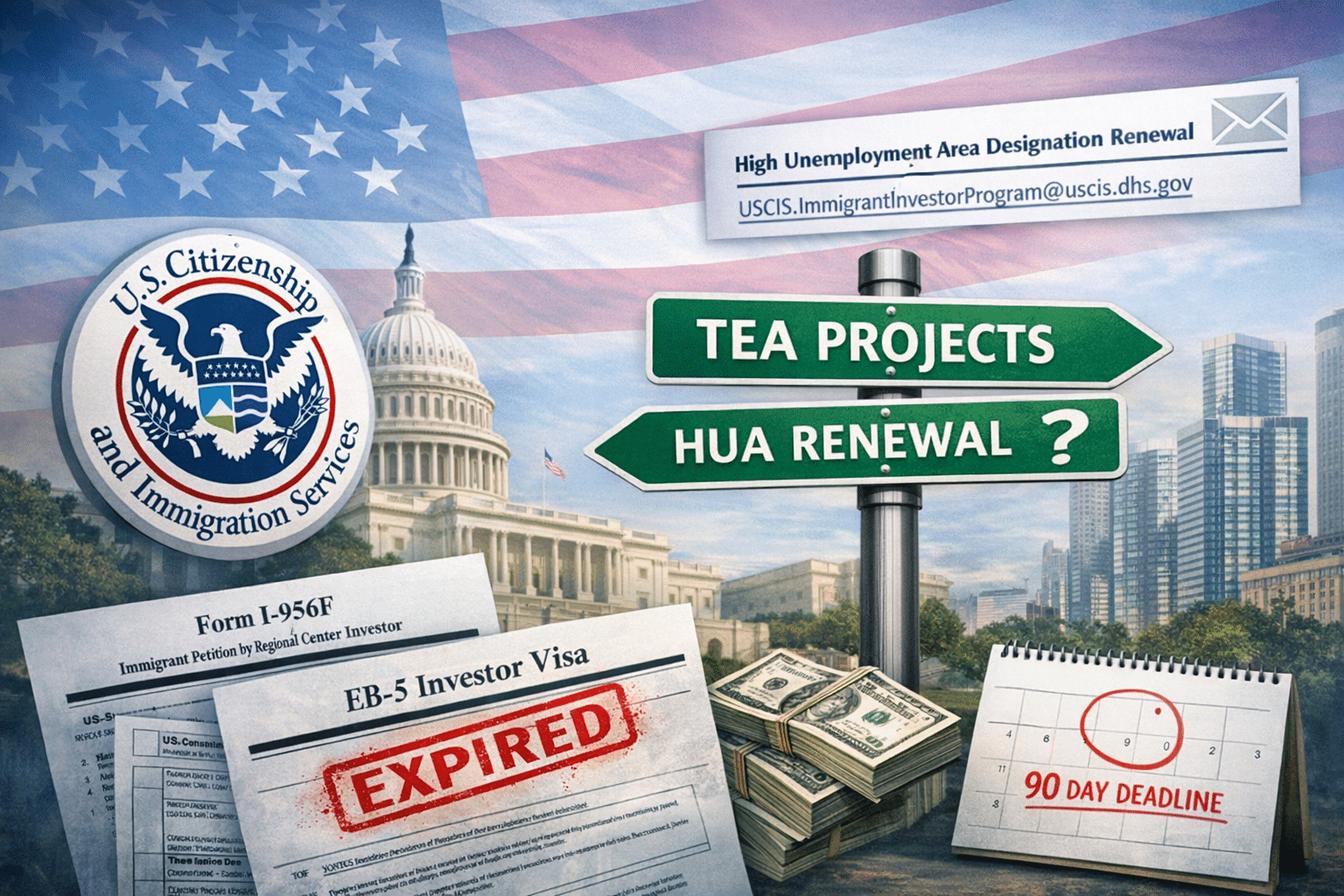
The most notable addition for urban TEA offerings is the new High Unemployment Area Designation Renewals section. In it, USCIS explains that a regional center should decide whether to request renewal of an HUA designation for an approved Form I-956F by looking to “whether the offering is fully subscribed” and “whether all investors have invested the required amount of capital within the designation period.” That framing is important. It suggests USCIS is treating HUA designation not merely as a filing-date issue, but as an ongoing project-administration issue with direct implications for subscription timing, investor funding status, and continued reduced-investment eligibility.
What USCIS Now Says
USCIS confirms that investors who invested the required amount while the HUA designation was in effect generally do not need to make an additional investment if the designation later expires. At the same time, USCIS warns that if the designation is not renewed, existing or newly subscribed investors who have not invested the required amount may need to invest the standard amount, unless another reduced-investment basis applies, such as rural or infrastructure qualification.
USCIS also lays out a specific renewal process. Renewal requests are to be submitted by email to the Immigrant Investor Program mailbox with the subject line “High Unemployment Area Designation Renewal,” along with the approved I-956F receipt number or I-526 receipt number and supporting evidence. USCIS states that, to avoid interruption, renewal requests should be filed at least 90 days before the end of the two-year designation period. The agency further states that it may provisionally extend the HUA designation from the receipt date of the renewal request until a decision is made. It also says there is no current fee for renewal requests. And notably, USCIS says it will reject and refund Form I-956F amendments filed only to seek HUA renewal, while amendments that also report material changes will not be rejected or refunded on that basis.
Why This Matters for EB-5 Regional Center Projects
For project sponsors and regional centers, this update has immediate operational significance:
First, USCIS has effectively created a new compliance calendar item for urban TEA offerings. Projects that continue to raise capital near the end of the two-year designation period may now need to make an affirmative strategic decision about whether and when to seek renewal. The agency’s 90-day recommendation should be read as more than housekeeping. It is a signal that USCIS expects projects to manage HUA validity proactively, not reactively.
Second, this guidance may affect subscription and funding practices. A project may be fully subscribed on paper but still have investors who have not yet contributed the full qualifying amount. USCIS appears to distinguish between investors who already “invested the required amount” during the designation period and those who have not. That distinction could prove consequential in offerings that permit staged funding, delayed final contributions, or other capital-call structures.
Third, offering documents for urban TEA projects may need to be revisited. Risk factors, subscription materials, and investor FAQs should consider explaining what happens if HUA designation expires before an investor completes funding or before a later investor subscribes. Projects may also want to state whether they intend to seek renewal and on what timetable. None of this guarantees a USCIS result, but clearer disclosure may help reduce misunderstandings and better align investor expectations with project administration realities.
Why this Matters for Investors
For investors, the update highlights a practical but important point: eligibility for the reduced investment amount may turn on timing, not just geography. USCIS states that investors who filed or invested at the reduced amount after HUA expiration, or who did not invest the required amount before expiration and whose regional center did not seek renewal, “may need to invest the standard investment amount,” unless another reduced-investment basis applies. USCIS also indicates that such petitions will be evaluated individually.
That language does not mean every petition will fail if renewal was not sought. But it does mean investors should understand the status of the project’s designation period, whether renewal has been requested, and whether their own capital contribution was completed during the relevant validity window. Investors considering urban TEA offerings late in the designation cycle may want to ask direct questions about expiration dates, renewal timing, and whether the project has another reduced-investment basis.
A Few Observations From the Update
This new guidance is notable not only for what it says, but for what it suggests. USCIS appears to be moving toward a more operational, lifecycle-based approach to TEA administration. Under that view, HUA designation is not merely something established at the I-956F stage and then forgotten. It is a designation with an expiration date, a renewal process, and potential consequences for investors who are not yet fully funded when the clock runs out.
The update also reinforces the importance of distinguishing among different investor fact patterns within the same offering. A project may have some investors who clearly locked in reduced-investment eligibility during the designation period, while others may face additional scrutiny if they subscribed later or completed funding later. That makes investor-level tracking more important than ever.
Finally, the agency’s decision to require email renewals instead of standalone I-956F amendments filed solely for that purpose suggests USCIS is trying to create a more streamlined administrative process. But it also means internal project teams must know the correct procedural path. A project that uses the wrong vehicle may lose time, even if USCIS ultimately rejects and refunds the filing.
Key takeaways
For urban TEA projects, the revised USCIS Q&A should prompt a fresh review of internal timelines, offering disclosures, and investor-funding procedures. Regional centers and project sponsors should identify the HUA expiration date for each approved project, assess whether the offering is fully subscribed, confirm which investors have fully invested during the designation period, and determine well in advance whether a renewal request should be submitted. Investors, in turn, should understand that reduced-investment eligibility may depend on more than the project’s location alone. Timing and project administration now appear to matter in a very direct way. Contact us if you have further questions about this update.
FAQ
1. What is the main change in the USCIS update?
USCIS has added a specific process and guidance for renewing a high-unemployment area designation tied to an approved Form I-956F. The agency now explains when renewal may be needed, how to request it, and what may happen if it is not requested.
2. Does every urban TEA project need to request renewal?
Not necessarily. USCIS says the regional center should evaluate renewal based on whether the offering is fully subscribed and whether all investors have invested the required amount within the designation period.
3. If an investor already invested the full required amount during the designation period, does expiration later matter?
USCIS says investors who invested the required amount while the HUA designation was in effect generally do not need to make additional investments just because the designation later expires.
4. What if the investor has not fully invested before the HUA designation expires?
USCIS says that, if renewal is not requested, the investor may need to invest the standard minimum amount unless another reduced-investment basis applies, such as rural or infrastructure status.
5. How is a renewal requested?
USCIS says the request should be emailed to the Immigrant Investor Program mailbox using the subject line “High Unemployment Area Designation Renewal,” with the applicable receipt number and supporting evidence.
6. When should the renewal request be filed?
USCIS recommends filing at least 90 days before the end of the two-year designation period to avoid interruption in reduced-investment eligibility.
7. Is there a filing fee for renewal?
USCIS says there is currently no fee for a renewal request, though it notes a fee could be adopted in future rulemaking or form revisions.
8. Can a project request renewal by filing an I-956F amendment?
USCIS says amendments filed only to seek HUA renewal will be rejected and refunded. If the amendment also reports material changes, USCIS says it will not be rejected or refunded on that basis.
9. Does USCIS provide a provisional extension while the renewal is pending?
USCIS says it may provisionally extend the HUA designation from the receipt date of the renewal request until it makes a determination.
10. What should investors ask before subscribing to a late-stage urban TEA offering?
Investors should ask when the current designation expires, whether renewal has been requested, whether the project has another reduced-investment basis, and whether their own capital contribution will be completed during the designation period.








Ask Us
Your Question
You have reached the limit of the number of messages you may submit using this form.






 English
  Português do Brasil
  Español
  Italiano
  Français
  Русский
  简体中文
简体中文  Deutsch
  Nederlands
  Dansk
Dansk  日本語
日本語  Português
  Polski
  Čeština
  Română
  עִבְרִית
  Tiếng Việt